Financed by America for Bulgaria Foundation
 |
The America for Bulgaria Foundation (ABF) is an independent, nonpartisan, and nonpolitical American grant-making foundation working in partnership with Bulgarians to strengthen the country’s private sector and related democratic institutions. For more information, please visit www.us4bg.org.
Support for the Access to Information Programme is provided by the America for Bulgaria Foundation. The statements and opinions expressed herein are solely those of the Access to Information Programme and do not necessarily reflect the views of the America for Bulgaria Foundation or its affiliates.
The project aims:
• Access to information and transparency legal framework that implemented by public bodies in line with international standards.
• Society is aware of their right to information, and there are critical and free media, journalists and independent civil sosiety organizations.
• An environment where freedom of information and expression and other fundamental rights are protected and there is rule of law and democracy.
Activities:
- Access to information legislation and implementation in line with the Freedom of Information standards
- Defending freedom of expression and the civil society environment
- Awareness-raising of the public at large, and improved skills of CSOs, media and journalists to exercise their right to information
- AIP’s Organizational Development
RESULTS
Within the framework of the project, the Access to Information Programme (AIP) prepares, submits, and presents statements on proposed legislative amendments. These are available in the “Legal Opinions” section (in Bulgarian).
Detailed information about the cases in which the legal team provided legal assistance during the project period can be found in the “Cases” section.
Information about court cases concerning access to information, supported by AIP during the reporting period, is published in the “Litigation” section.
***
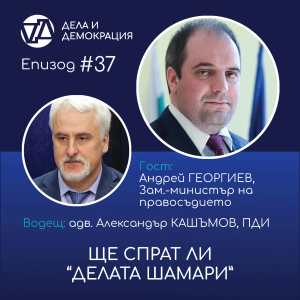
On a regular basis, twice a month, we publish a new episode of the video podcast “Dela i Demoktatsia”. The video podcast is dedicated to court cases accompanying democratic processes in Bulgaria.
The episodes are produced as a partnership between the Access to Information Programme and KAYA PRO Ltd.
***
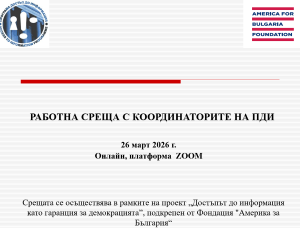
On 26 March 2026, the Access to Information Programme Foundation held its traditional annual online meeting with coordinators from the AIP journalists’ network across the country.
The regional coordinators of AIP presented their reports and comments on information disclosure practices in the country and outlined an up-to-date picture of the state of access to information at the local level. They shared their own experience in seeking information from local institutions, the specific cases they had worked on over the past year, and their observations regarding the proactive publication of information on institutional websites.
The AIP team, in turn, presented the results of the organisation’s activities for 2025 – the projects we are working on, the outcomes of our advocacy efforts, the monitoring of practices, the legal assistance provided, as well as awareness campaigns and training activities. The coordinators were informed about legislative trends and problems from the past year up to the present moment; a summary was presented of the legal aid cases received over the past year and the most significant case law developments concerning access to public information; AIP’s information channels were also reviewed.
Reports of AIP coordinators (in Bulgarian) are published in the AIP newsletter.
***
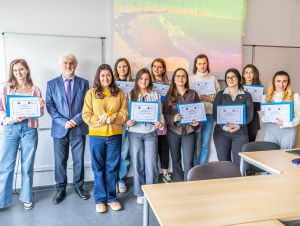
On 16 January 2026, the Access to Information Programme awarded certificates to students from the New Bulgarian University for successfully completing the practical course “Access to Information and Public Communications.” The course took place from 12 November 2025 to 16 January 2026. The lecturers were AIP Executive Director Alexander Kashumov and Kiril Terziyski and Stefan Angelov from the AIP legal team.
Seventeen students from the bachelor’s programmes in Journalism and Public Relations were introduced to the standards and legislation in the field of access to information, as well as to examples from the practice of implementing the Access to Public Information Act. The students prepared requests for access to information and submitted them electronically to various institutions. The topics concerned issues of personal interest, matters currently present in public discourse, or existing issues of public importance and problems in the regions where they live. AIP lawyers provided consultations on drafting the requests and identifying the relevant institutions.
Requests were submitted to municipal administrations; the Road Infrastructure Agency; the Pleven Regional Governor; the Urban Mobility Center; Sofia Public Transport EAD; the Ministry of Health; the National Railway Infrastructure Company; the Pleven Regional Education Department; and the Executive Agency ‘Medical Supervision’.
The students’ questions concerned deadlines and funding for road repairs in Sofia and Burgas; transport problems in Sofia; air quality in the Sofia district of Poduene; transparency of media-related expenditures by the Ministry of Health; railway line modernization; plans for repairing neglected playgrounds; conditions for teacher recruitment competitions; youth employment support programmes; conditions and adoption campaigns in animal shelters under the Sofia Municipality; planning of repairs on a specific third-class road; waste collection control and practices in Burgas; and measures to be taken by the relevant institutions in cases involving a missing life-sustaining medication.
As part of the practical assignment, the students became familiar with the procedure for requesting information and encountered the formal implementation of the law and its limitations. We wish the students to continue their projects by submitting follow-up requests in cases of lack of response or when clarifications and new inquiries are needed.
With gratitude for the course and an assessment of its usefulness, here is what some of the students shared:
“The course helped me communicate more confidently with institutions.”
“As an active citizen, I will continue to apply what I have learned.”
“I learned about the course last year and did not hesitate to enroll.”
***
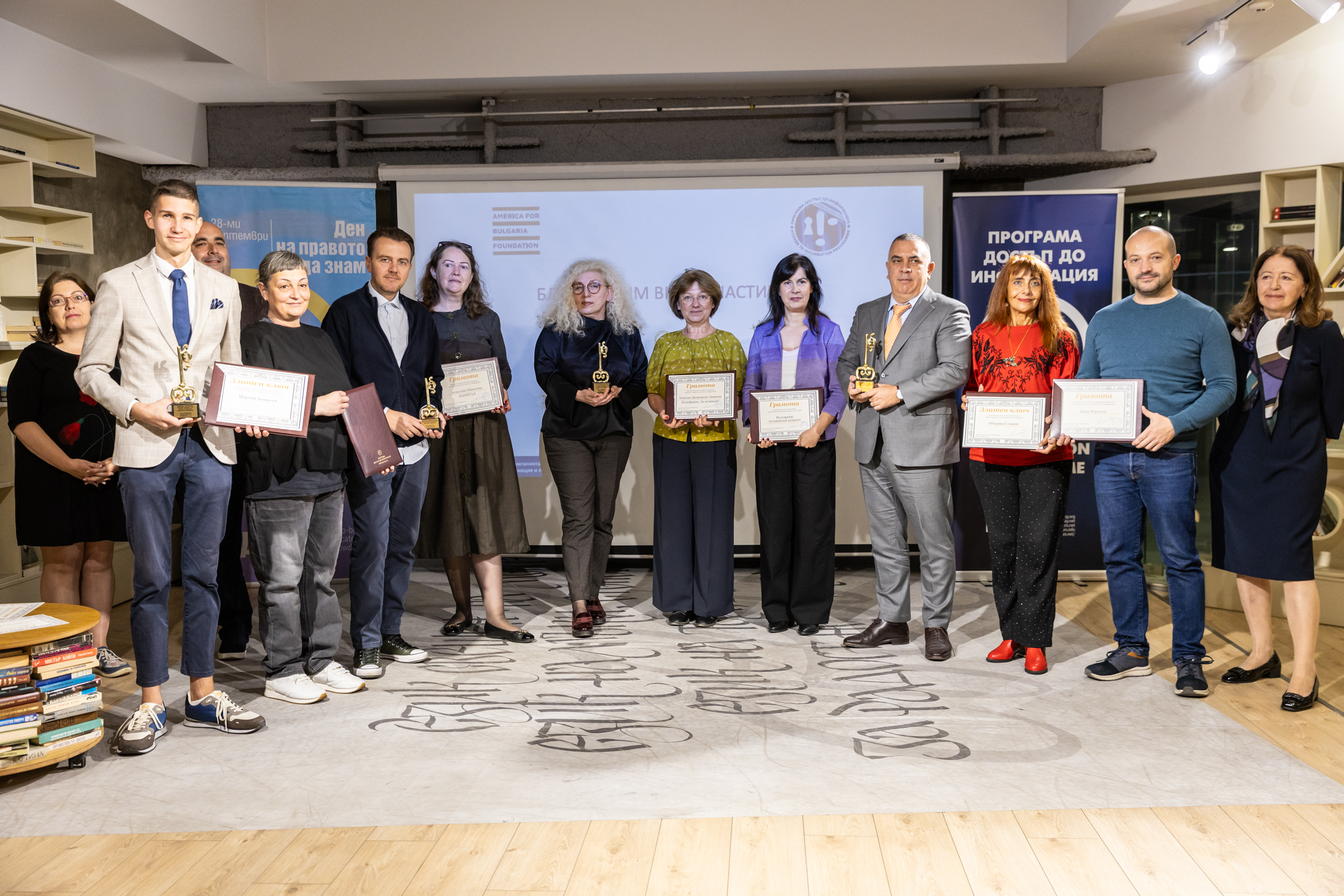
Access to Information Programme presents its annual awards for contributions in the field of freedom of information to celebrate the International Right to Know Day.
The ceremony is held at the Literary Club Peroto, National Palace of Culture, with the participation of citizens, journalists, representatives of civil society organizations and state institutions.
The 2025 awards are in the traditional six categories.
Golden Key Award goes to:
Martin Atanasov – creator of the Black Run map, a clear, structured, and accessible visualization of road traffic accidents in Bulgaria. To collect the necessary data, he submitted access to information requests to the Ministry of Interior and the Road Infrastructure Agency (RIA). RIA refused to provide the data, but Martin appealed before the Sofia City Administrative Court, drafting the complaint himself. The Black Run platform contains data on 177,000 accidents in Bulgaria in the period 1 January 2021 – 14 April 2025. The initiative aims to gain deeper understanding of the causes of accidents.
Honorary Diploma goes to:
Boyan Yurukov – blogger who, through an access to information request, asked for the list of 4,400 properties the state planned to sell. Mr. Yurukov collected the addresses into a map showing city streets, inter-block spaces, historical landmarks, cultural and sports zones, attractive resort properties, and even entire peninsulas. His work raised important public questions – in whose interest is the sale; is it necessary; why are the properties not being given to municipalities, etc.
Category “NGO that used the right to information most actively”
Golden Key Award goes to:
Institute for Market Economics (IME) for using access to information requests to prepare analyses, publications, and commentaries that enhance transparency and increase civic engagement regarding local development. An example is their annual edition Regional Profiles – Indicators of Development, which assesses regional economies. For several indicators, IME submits requests to all municipalities each year. In 2025, they submitted 265 requests, and since 2012 a total of 3,445. The data is processed and made available on IME’s website and is used in Regional Profiles and other research on local development, tax policy, decentralization, local services financing, municipal administrative capacity, and more.
Honorary Diploma goes to:
Bulgarian Helsinki Committee (BHC) for using access to information requests to reveal how the Prosecutor General exerts significant control over the activities and administration of the special prosecutor tasked with investigating crimes committed by the Prosecutor General or his deputies. The information was obtained as part of BHC’s consistent efforts to increase transparency in the prosecution system.
Category “Best journalist campaign/article related to the right to information”
Golden Key Award goes to:
Yanka Petkova, OFFNews, for a series of articles based on data obtained through access to information requests about the opaque spending of funds under the national program for promoting transplants, survival rates after transplants in Bulgaria, and a specific case of a patient who died from a hospital-acquired infection after transplantation. Following her publications, the issue of transplants and the irresponsible attitude of the Executive Agency “Medical Supervision” came to the fore. Her persistence and constant pressure on institutions exposed many dubious practices and brought the topics of transplantation and organ donation into the public spotlight.
Honorary Diplomas go to:
-
Desislava Nikolova, Capital, for systematic, large-scale investigations into the functioning of the healthcare system in Bulgaria, using access to information procedures. Her investigations, addressing matters of life and health, raised issues for public debate, caught the attention of the Sofia City Council and other institutions, questioned decision-making in the National Health Insurance Fund, and exposed previously hidden healthcare problems.
-
Emiliya Dimitrova, Za Istinata, who submitted a request to the mayor of Sevlievo Municipality for the schedule of construction works under a project to reconstruct and replace water pipelines in the town center. After the municipal secretary denied access, she appealed with AIP’s help before the Gabrovo Administrative Court. The court overturned the refusal, and the case was reported in Za Istinata.
Category „Institution that has organized the provision of public information most efficiently"
Golden Key Award goes to:
Sliven Municipality, which, since the adoption of the Access to Public Information Act 25 years ago, has consistently maintained a high standard in its application and serves as a model. Both municipal leadership and the administration responsible for the Act show continuity, precision, transparency, consistency, and innovation.
Category „Institution that does not fulfill its obligations under the APIA and violates citizens’ right to information”
Padlock Anti-award goes to:
Executive Agency “Medical Supervision” for refusing journalists access to information related to projects under the National Program for Promoting Organ Donation and Transplantation 2024–2028. Instead of improving transparency and complying with court rulings that third-party protection cannot justify full denial of information on public spending, the agency continues to refuse, hiding behind third-party consent. Such practice is especially harmful in healthcare, given that this is the sole central authority responsible for controlling medical care quality and organizing transplant activities, and its refusal to act transparently undermines protection of citizens’ health rights.
Dishonor Award goes to:
The Special Prosecutor for investigating the Prosecutor General and his deputies – access requests addressed to Daniela Taleva are redirected to the Deputy Prosecutor General. This paradoxically allows those under investigation to decide whether information on relevant cases should be disclosed. As a result, refusals have become standard practice.
Category „Most absurd and/or funniest case involving access to information”
Tied Key Anti-award goes to:
Mayor of Galabovo Municipality, for hiring a lawyer to contest journalist Venelina Popova’s appeal against a silent refusal, with the obvious aim of claiming costs from her, despite the municipality having its own legal counsel. The mayor’s notification that the municipality does not have the requested information was unconvincing. After securing a court ruling against the journalist for costs, the mayor transferred the case to a private bailiff, who forced her to pay BGN 1,000 in legal costs, plus nearly the same amount again for enforcement and attorney fees. To collect the sum, the bailiff froze her bank accounts and pension and scheduled an inventory of her household belongings.
The full reasoning for each of the 27 nominations can be found on the special Right to Know Day webpage.
Interviews with the awardees will be published in AIP’s Newsletter and on the Right to Know Day page. Follow us on Facebook.