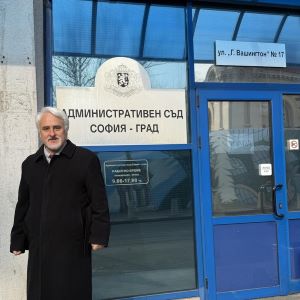
On February 26, the Sofia City Administrative Court gave the go-ahead to a case brought by citizens against a decision of the Commission for Personal Data Protection (CPDP), which had “pardoned” the political party Vazrazhdane for publicly publishing online in 2022 nearly 1,000 Bulgarian personal identification numbers (EGNs). The court ordered the CPDP to submit missing documents from the case file and allowed the hearing of a witness. The case was filed by citizens who are members of boards of various non-governmental organizations and commercial companies.
The case originated in August 2022, when the party publicly released the personal data of hundreds of Bulgarian citizens in a document hundreds of pages long, which accompanied a so-called “signal” submitted by the far-right formation to the prosecution. In this signal, the individuals were stigmatized as “foreign agents” and “American agents,” with the obvious aim of justifying Vazrazhdane’s draft Law on Foreign Agents, modeled on a Kremlin-style template. The EGNs were removed from the party’s website after it was awarded the “Big Brother” anti-award in January 2023 for violating the principles of personal data protection.
The violation, which representatives of Vazrazhdane initially denied having committed, was conclusively proven and later acknowledged by them during hearings before the CPDP. The Commission established that a violation had occurred but accepted that the data had been collected and published for the purposes of a journalistic investigation, which, although disproportionate, was overall legitimate. On the other hand, there was no ruling on the main argument of the complainants—that they and hundreds of other citizens were stigmatized with the aim of inciting hatred, following the pattern of fascist and communist regimes. Ultimately, the CPDP recommended that Vazrazhdane improve its personal data protection rules and appoint a responsible officer, without imposing a fine for the violation.
“The facts show that if not restrained by firm legal measures, activists of the far-right formation and their supporters are inclined to escalate, to commit violence, and to endanger and violate the rights of others and the foundations of democracy and the rule of law. The weakness, inaction, and irresponsibility of institutions turn citizens into permanent victims of violations, threats, and violence. It must not be allowed for the attacks of a handful of marginal figures against people and their rights and freedoms, legality, and European values to take over the atmosphere of public life, bringing back the times of Nazism and communism. It is necessary to withstand the attempt at Putinization by relying on the principles of law, the protection of fundamental rights, and their main guardian—the independent court,” noted Alexander Kashumov, Executive Director of the Access to Information Programme, who is the lawyer for the complainants.
The next hearing in the case is scheduled for March 12, 2025.