The legal representative of the complainants, attorney Alexander Kashumov, Executive Director of the Access to Information Programme, stated that “the citizens’ data were deliberately and systematically collected, processed, and published in violation of the General Data Protection Regulation (GDPR). This constitutes the most serious breach of personal data protection since the adoption of the Personal Data Protection Act in 2001. This is because it was carried out with the aim of stigmatizing individuals, fostering hatred in society, and provoking intolerance, in violation of the fundamental principles of law and the protection of human rights. It is well known that groups close to ‘Vazrazhdane’ have undertaken actions to restrict citizens’ rights and to commit violence against individuals and property. In this context, the unlawful disclosure of personal data is perceived by the victims as a threat. This cannot and should not be tolerated in a state governed by the rule of law.”
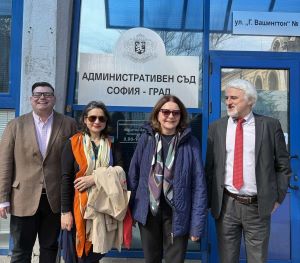
On March 12, 2025, a second hearing was held at the Sofia City Administrative Court in the case filed by 22 representatives of civil society organizations in connection with the disclosure by the party “Vazrazhdane” of more than 800 personal identification numbers (EGNs) of Bulgarian citizens.
The case was brought after the Commission for Personal Data Protection established that “Vazrazhdane” had committed a violation in publishing these personal data but effectively “pardoned” the party by issuing recommendations instead of imposing sanctions. The complaint was filed after, in 2022, the political party announced that it was submitting a report to the Prosecutor’s Office against alleged foreign agents and attached to this report a document of several hundred pages containing the full names and personal identification numbers (EGNs) of members of governing and supervisory bodies of non-governmental organizations that had received funding from the “America for Bulgaria” Foundation. The aim of “Vazrazhdane” was to justify its first proposal for a Draft Law on Foreign Agents.
The data of Bulgarian citizens remained online for a period of nearly six months. To this day, “Vazrazhdane” continues to insist on the adoption of such a law.
At the hearing on March 12, 2025, a witness was questioned who confirmed the publication of hundreds of EGNs, previously certified by two notaries. An excerpt from a new publication was also presented, showing that although “Vazrazhdane” had removed the EGNs from its website in February 2023, they remain accessible on the internet to this day on another platform and are even being sold in exchange for entered credit card details.