
On 28 January, we observe International Data Protection Day. The event traces its origins to the adoption of the first international legal instrument on personal data protection—Council of Europe Convention 108, adopted on 28 January 1981, for the protection of individuals with regard to automatic processing of personal data.
Personal data protection and the right of access to public information are two sides of the same coin, symbolizing the principle that citizens have the right to know as much as possible about the state, while the state should know as little as possible about its citizens. This principle holds in democratic countries, whereas in totalitarian and authoritarian regimes, the opposite occurs.
On 28 January, in many countries around the world, “Big Brother” anti-awards are also often presented. These awards are given to government bodies, companies, or individuals who violate the right to privacy and the protection of personal data. The award (Big Brother) was established by the Privacy International, dedicated to protecting personal rights.

In Bulgaria, the “Big Brother” anti-awards are traditionally presented on this date once every few years by the Internet Society - Bulgaria and the Access to Information Programme. The most recent anti-award was given in 2023, when a specially selected jury unanimously chose the political party “Vazrazhdane” as the recipient of the “Big Brother” anti-award among all nominations, due to the deliberate violation of the right to personal data protection in order to deliberately single out and stigmatize a group of people. This followed an incident in 2022 when the party published the personal identification numbers (EGNs) of more than 800 citizens online, declaring them to be foreign agents at a press conference.
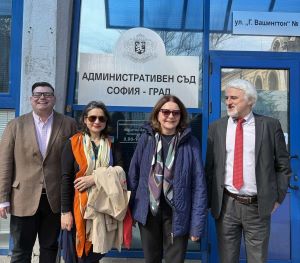
The Access to Information Programme supported a lawsuit filed on behalf of 22 complainants from the “list” against the party “Vazrazhdane.” As a result of the complaint, the Commission for Personal Data Protection found a violation of the General Data Protection Regulation (GDPR). The case is continuing with the aim of imposing a sanction on the offending party, which has not yet happened. A hearing is scheduled before the Supreme Administrative Court on April 3, 2026, at 11:00 a.m.
The Bulgarian state is indebted to its citizens also because it has still not implemented the 2022 judgment of the European Court of Human Rights in the case brought by lawyer Mihail Ekimdzhiev, the Access to Information Programme, lawyer Kashumov, and the Association for European Integration and Human Rights. In its ruling, the Strasbourg court found that Bulgaria operates an uncontrolled system for the use of special surveillance means (wiretapping) and for state institutions’ access to data on people’s electronic communications traffic.