


Information newsletter
Issue 1(13), January 2005
Monitoring Access to Information in Practice: Where
do we stand? Where we can1
Gergana Jouleva, AIP
How is it possible to compare access to information practices in different countries? Do these practices improve with the adoption of freedom of information laws; do citizens receive the requested information on time?
Although difficult, this is not an impossible task.
First you select requestors of several types - journalists, NGOs, neutral citizens ("the man on the street", non-identifiable by the institution by occupation or social group), businessmen, and minority groups or people with disabilities. Then the national team agrees on the institutions and the topics of submitted requests. The request procedure starts simultaneously in all participating countries and the monitoring ends at a determined time, set after considering the procedures of national freedom of information legislation. In order not to complicate the monitoring process further, the requested information should not fall into any of the access to information restrictions. After the first monitoring stage, which examines how APIA procedures are followed, the goal of the project is announced and additional information is requested from all monitored institutions. All this requires some hypothesis clarification and lots of enthusiasm from the national teams to start with. And ends with interviewing FOI officials in all monitored institutions.
In 2003, one hundred requests were filed to eighteen institutions by ten requestors. In 2004 140 requests were filed to eighteen institutions by seven requestors.
Theoreticians might feel offended by the simplicity of this project, but it was only achieved after serious analyses of international standards and national legislation, after an extensive period of monitoring access to information practices by all partner organizations, and after lively debates.
What were the results for 2004 compared to those in 2003?
1. Unable-to-submit: An “unable-to-submit”
outcome describes cases where it is not physically possible to file the
request. For example, some requestors could not get into the relevant
institution, because the guard did not admit them. Or, once inside, requestors
could not speak to the relevant person, because they were, for instance,
absent, always “at lunch” or “coming in tomorrow.” Like last year, these
outcomes make filing an oral request impossible. In 2004 there were only
two such cases - when no official able to answer the request could be
identified.
2. Oral refusal: An oral refusal is when a representative of the authority states verbally that s/he refuses to provide the information, whether or not grounds are given. In Bulgaria these refusals are often accompanied by a recommendation for filing a written request. During the interviews in most institutions this outcome was explained with the incapability of those officials working with citizens to provide information, which is usually held in other departments. In most of these cases additional conversations with people having different reception hours were required. So, in cases when information was not readily available, the easiest answer had been: "file a written request".
3. Written refusal: A written refusal is a decision not to provide the information made in any written form. The number of such refusals in 2004 was 25 out of 122 written requests.
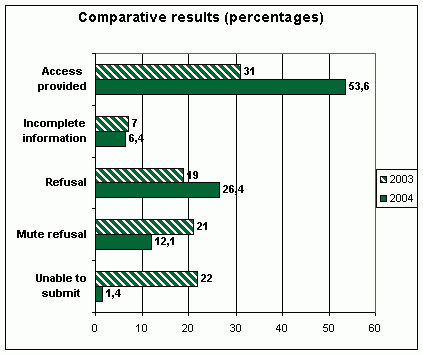
4. Mute refusal: This category indicates no response at all from the authorities. This outcome was recorded after all the legal timeframes for answering the requests has expired often with a generous margin given to the authorities to respond. When no answer was given in response to a clarification request, this was also considered a mute refusal. There is a significant improvement in the results from the 2004 monitoring compared to 2003- while in absolute figures the numbers were close (19 and 17) mute refusals dropped from 21% to 12%. Also, during the second monitoring stage, when we filed requests for information, which institutions were obliged to prepare and publish, one of the municipalities provided absolutely no answer.
5. Fulfilled request: This category includes all cases when information has actually been provided, although there were cases where information was not complete or instead of the requested existing documents, a list of names or companies had been provided (nine cases in 2004).
Negative interpretation of the results:
As in 2003, requestors had difficulties receiving information following
the oral requests they submitted during the first stage of the monitoring.
The difference in 2004 was the significantly lower number of "unable
to submit" results (only 2 compared to 22 in 2004). Despite that,
requestors were often still unable to receive the requested information,
because most oral requests they were able to submit in 2004 were actually
refused (12 cases).
The percentage of overall information refusals has increased from 19 to 26. Access to information has not become easier - officials had learned how to refuse information while following the letter of the law. The monitored institutions did not show significant improvement in actively providing guidelines on how people could exercise their right of information access.
Positive interpretation of the results:
As mentioned, in 2004 the number of "unable to submit" requests was two, while in 2003 they were twenty two.
The number of mute refusals has declined from 21% in 2003 to 12% in 2004. The percentage of completely fulfilled requests has increased.
All institutions visited for this project had appointed an official responsible for working under the Access to Public Information Act. Internal rules for handling information requests have been adopted in most obliged institutions, and request registers have been created.
The Ministry of Defense has made available the handbook "How to get Access to Information," published by AIP. The handbook was also published on the web page of the Ministry.
The law is now well known and attention is turning to the details.
If you want to compare your own experience in seeking information with the standards in the area, you should read the annual Access to Information Report, which will be published soon by Access to Information Programme.
1. The "Monitoring of access to information" project was implemented for the second time in Bulgaria. The methodology was developed by the Open Society Justice Initiative (http://www.justiveinitiative.org) after discussions with partner organizations from five countries in 2003 and sixteen organizations in 2004.
HOME | ABOUT US | APIA | LEGISLATIVE BASE | LEGAL HELP | TRAININGS | PUBLICATIONS | FAQ | LINKS | SEARCH | MAP
English Version • Last Update: 05.02.2005 • © 1999 Copyright by Interia & AIP